
| Monday: | CLOSED |
|---|---|
| Tuesday: | 11:00 – 20:00 |
| Wednesday: | 11:00 – 20:00 |
| Thursday: | 11:00 – 20:00 |
| Friday: | 11:00 – 20:00 |
| Saturday: | 11:00 – 17:00 |
| Sunday: | 11:00 – 17:00 |
| Monday: | CLOSED |
|---|---|
| Tuesday: | 11:00 – 20:00 |
| Wednesday: | 11:00 – 20:00 |
| Thursday: | 11:00 – 20:00 |
| Friday: | 11:00 – 20:00 |
| Saturday: | 11:00 – 17:00 |
| Sunday: | 11:00 – 17:00 |
Christine Swane: Singular and Multiform
September 26, 2026 – January, 31 2027
Christine Swane (1876–1960) was a wide-ranging artist with a poetic eye and a rare sense of colour. Painting was her point of departure, but in mid-life she also became a ceramicist and a textile artist, and as an older artist she executed a monumental mosaic.
This special exhibition celebrates the 150 years since Swane’s birth with the most comprehensive and varied presentation of her art to date. Here visitors can follow Swane's artistic development, her experiments, and her working processes; linger in her places – Kerteminde, Frederiksberg, Birkerød; and encounter her paintings, ceramics, and textiles in close interplay. This interplay that could also be found throughout Swane's own artist's home in Birkerød, where art was a natural part of everyday life.
The exhibition has been created in close collaboration with the Johannes Larsen Museum and Ribe Art Museum. It is accompanied by a richly illustrated book with new articles on Swane’s art and career.
Out of the Funen Painters' Circle
Christine Swane grew up in Kerteminde within the circle of the Funen Painters – Johannes Larsen was her elder brother, and Alhed Larsen was her sister-in-law – and like them, she took her bearings from nature and from what lay close at hand. At the same time, Swane went her own way, uncompromisingly pursuing her own dream of becoming an independent artist. In 1901, as a student at the Women’s Art School of the Royal Danish Academy of Fine Arts, Swane acted on her dissatisfaction with the instruction there. Together with fellow artists, among them Emilie Demant Hatt, Swane organised an alternative school in Kronprinsessegade with Fritz Syberg as their teacher.
From then on, Swane sought out an artistic education for herself – and here Karl Isakson, in particular, came to matter greatly to her. In 1910 she met Sigurd Swane, a colourist like herself; they married, had a son, Lars, and settled on Falkoner Allé in Frederiksberg. The marriage did not last long, however. In her Frederiksberg paintings, Swane lets the houses and the urban greenery, the potted plants on the windowsill and the washbowl in the kitchen, rise again as nearly abstract compositions in colour.
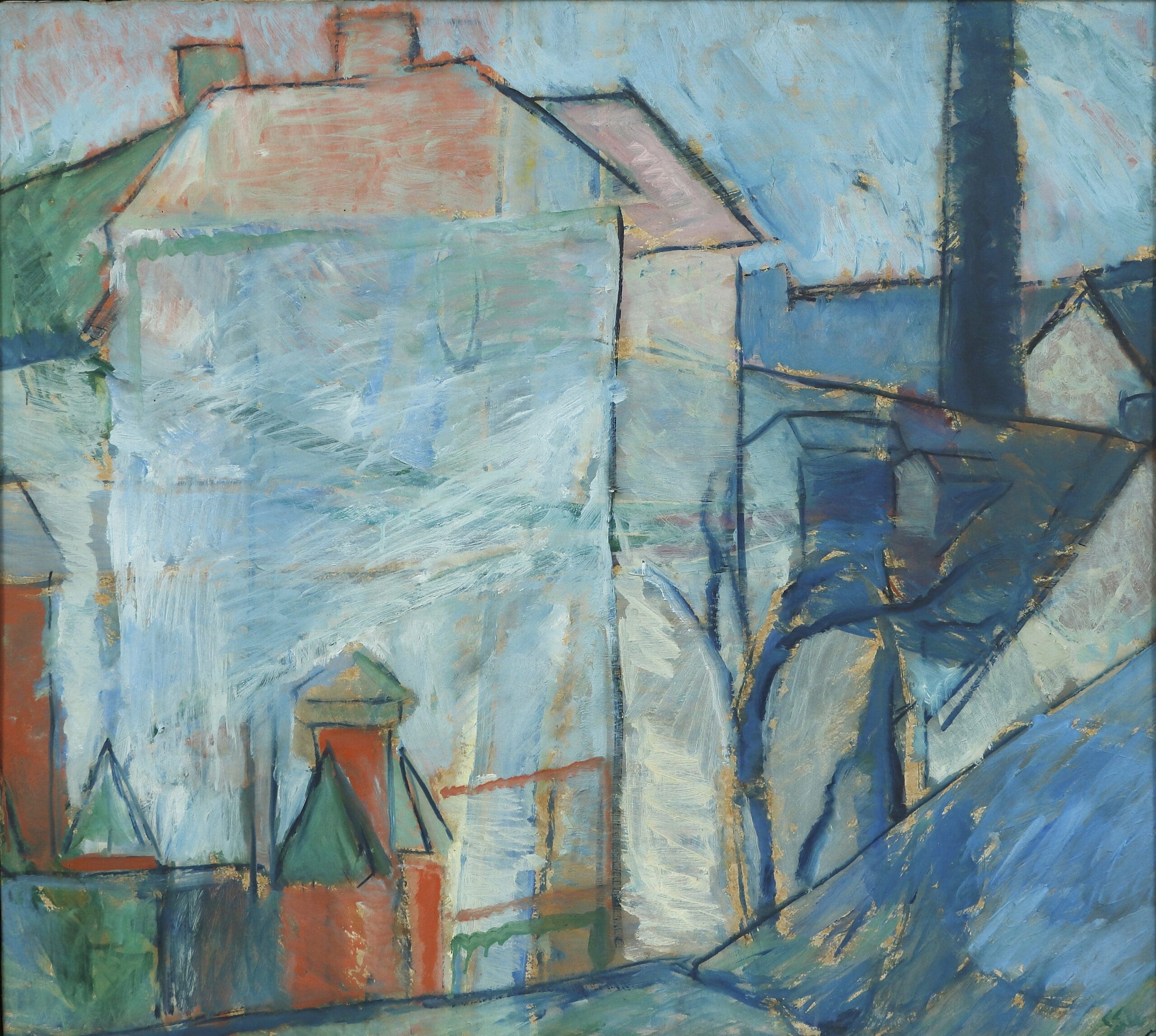
Christine Swane, House Gables (Falkoner Allé), undated, Johannes Larsen Museum
In Birkerød, the Ceramicist and Textile Artist Comes into Her Own
The next leap Christine Swane made took her out of the city to rural Birkerød, and into a fertile period as an independent artist. In Birkerød, it was Swane herself who created the setting for her life: in 1935 she had an apple-green Functionalist villa built, with a kiln, a greenhouse, and a garden – for herself, her son Lars, and her sister Marie Larsen, who kept house for her. Now Swane threw herself into ceramics in earnest. Bowls, vases, and dishes with animal motifs and abstract compositions, often in ultra-modern designs, emerged from the kiln in her house in large numbers.
Alongside this, Swane sewed patchwork compositions, and embroidered and printed tablecloths, place mats, and scarves. Sadly, only a few of Swane’s textiles survive, partly because museums long declined to regard textiles as “real” art. A special selection of these can be seen in the exhibition. In addition, the textile artist Anne Fabricius Møller has printed new textiles from Swane's pattern drawings, so that this under-recognised side of her art can be given its full due.
Christine Swane made her living from her art – and made a home with it, too, in her radiantly colourful artist's house. Her paintings hung on the walls, her ceramics and small sculptures stood on the windowsills, and she used the ceramics and the textiles in everyday life. Art and life were two sides of the same coin, and the house itself was an inexhaustible world of motifs. When she painted a still life, Swane would typically set it up on one of her own tile-topped tables, or with one of her own tablecloths as a backdrop. She would compose the still life from her own ceramics, coloured glass, flowers from the garden and greenery from the greenhouse. Every still life is thus a conglomerate of the artist’s home in Birkerød.
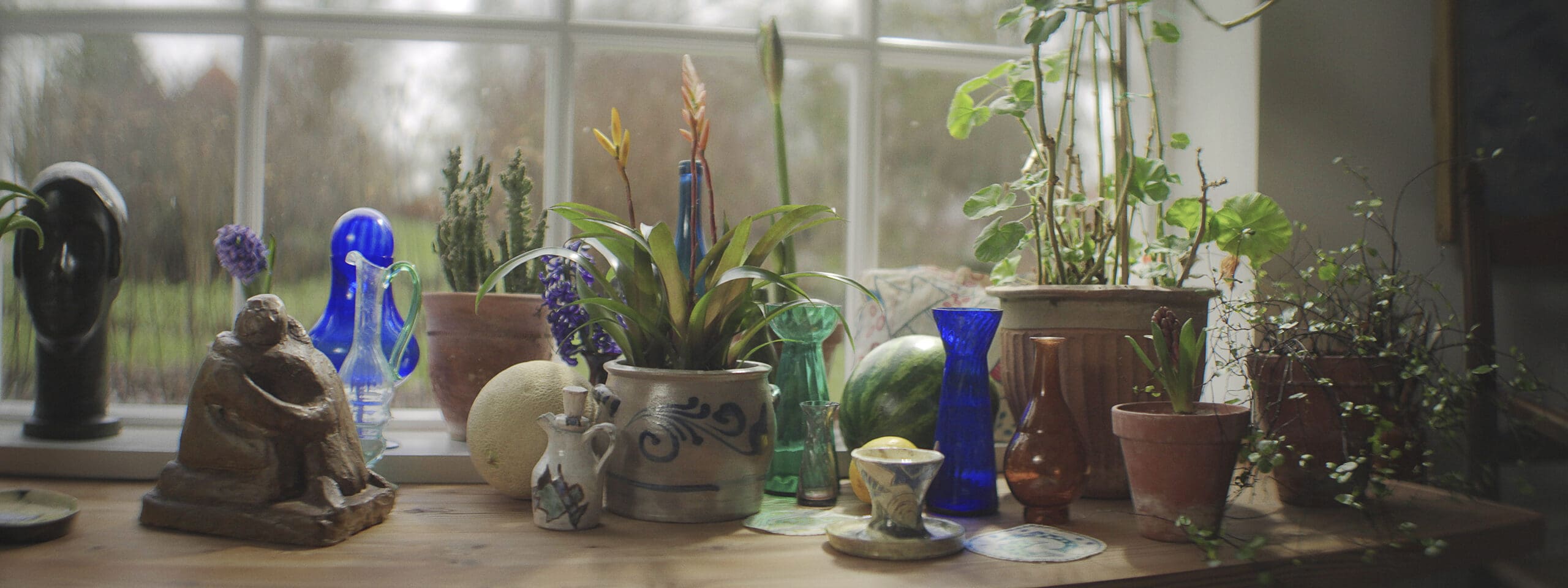
Reconstruction of Christine Swane's windowsill from the house in Birkerød. Still from the exhibition film, 2026. Photo: Morten Krüger
Back in Frederiksberg: The Mosaic for Damsøbadet
At the age of 72, Christine Swane took on a large public decorative art installation in a technique she had never tried her hand at before: mosaic. Recognition was now growing, and in 1948 she was both selected for the Venice Biennale and awarded the commission for Damsøbadet, the public swimming baths in Frederiksberg.
The mosaic shows three women gymnasts practising in brilliant sunshine under a blue sky; but it is also an abstract composition in colour, made up of many glittering facets. Through film clips and original material, the exhibition offers an insight into the demanding working process behind the mosaic, which measures more than 3 × 3 metres – a process that also involved Swane's son, the artist Lars Swane, who assisted his mother on many occasions.
Christine Swane remained active to the end, and as late as 1957 she made a long journey abroad to the San Cataldo retreat in southern Italy, accompanied by Lars Swane. By then she had moved in with his family in Farum, and in the summers the two of them painted at their shared house at Holtbjerg in North Jutland. Several of Swane's best-loved paintings come from there, among them Spruce Forest, which is on display in the exhibition.
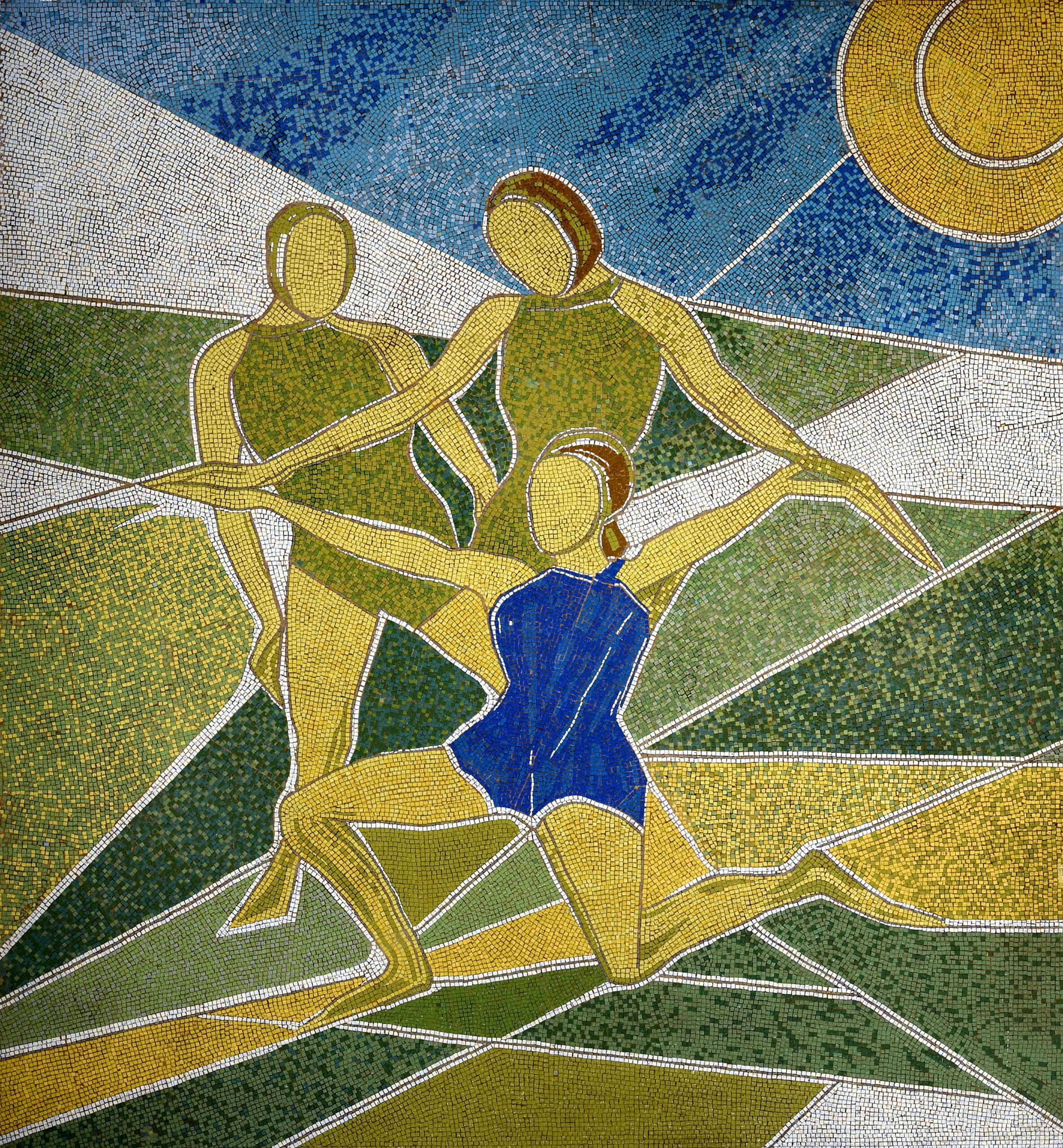
Christine Swane, Figural Composition, 1951, Damsøbadet, Frederiksberg
More Christine Swane: A Collaboration with the Hirschsprung Collection
The interest in Christine Swane is growing, and autumn 2026 offers an unparalleled opportunity to see her art at two museums on the island of Zealand. Alongside the solo exhibition at the Nivaagaard Collection, the Hirschsprung Collection in Copenhagen has a group exhibition about the three artist couples Alhed and Johannes Larsen, Anna and Fritz Syberg, and Christine and Sigurd Swane.
The two museums have arranged that a visit to either exhibition earns the visitor a voucher, which can then be taken to the other exhibition and exchanged for a complimentary postcard.
Christine Swane: Singular and Multiform, The Nivaagaard Collection, September 26, 2026 – January 31, 2027
The Funen Painters. Art Above All!, The Hirschsprung Collection, September 18, 2026 –January 24, 2027
The exhibition is supported by the New Carlsberg Foundation, the Augustinus Foundation, the A.P. Møller and Chastine Mc-Kinney Møller Foundation for General Purposes, the Aage and Johanne Louis-Hansen Foundation, and the Beckett Foundation.

